


Smart Rental Strategies:
5 Tips for First-Time Property Investors
Practical information for Iowa and Nebraska investors navigating today's market.

Higher interest rates, limited housing inventory, and rising insurance and property taxes have changed the landscape for today's rental property investors. In many Midwest markets, opportunity still exists — but successful investing often involves thoughtful planning, realistic projections, and appropriate financing structure.
5 Essentials for First-Time Investors
1
Define Your Investment Goal
Are you building long-term wealth for retirement, or do you want reliable monthly income? Your "why" determines everything that follows.
- Property type — single-family vs. small multifamily
- Financing strategy and loan structure
- Cash flow expectations
- How long you plan to hold the asset
Having clear objectives provides a framework for evaluating potential properties that that may help you pursue long‑term investment goals such as building wealth or generating income.
2
Plan for Volatility
Rental property investing is not passive income without risk. Tenants move. Repairs happen. Expenses rise.
Maintaining cash reserves — typically 3–6 months of operating expenses — may help manage unexpected costs and reduce the impact of short‑term disruptions.
3
Choose the Right Ownership Structure
Many first-time investors consider forming an LLC for asset protection. The right structure depends on your broader financial and tax strategy.
Consult with your CPA and legal advisor before purchasing to determine how the rental property aligns with your long-term plan.1
4
Run the Numbers
In today’s market, most lenders require 20–25% down on rental properties, and rates are typically higher than owner-occupied mortgages. Look closely at projected rent, operating expenses, vacancy assumptions, and loan terms to ensure sustainable cash flow.
A property should work on paper before it works in practice.
5
Align With the Right Lending Partner
In tighter markets across Iowa and Nebraska, well-priced properties move quickly. Pre-planning your financing may help you act quickly when the right deal appears.
An experienced local lender can help you:
- Evaluate projected cash flow
- Structure appropriate loan terms2
- Understand investment property loan requirements
- Assess whether a deal truly supports your goals
The right banking partner doesn't just fund the purchase — they help you analyze it.
Ready to Purchase Your First Rental Property?
Before you purchase, let’s review your numbers together. A short conversation can help clarify whether a property truly supports your long-term goals.
Chris Blum
Senior VP & Chief Lending Officer, Midstates Bank
1851 Madison Ave, Suite 732, Council Bluffs, IA 51503
Information is for educational purposes only and does not constitute financial advice. Please consult with a lender to determine what strategies fit your situation. 1Midstates Bank does not provide legal or tax advice. Customers should consult their own legal and tax advisors regarding their specific financial situation. 2Loans and financial programs are subject to credit approval. Terms and conditions apply.
More Midstates Insights
Ag Insights | Cash Flow Strategies for Top-Performing Farms
Mastering Cash Flow: Advanced Strategies for Top-Performing Farms
.png)
Josh Hawkins, VP Regional Ag Manager – Midstates Bank
With over 15 years in ag finance, Josh has guided farms through cash flow challenges and growth planning. Raised in agriculture, he understands the cycles that drive long-term success.
Even high-performing farms encounter cash flow bottlenecks that can restrict growth. Optimized cash flow isn’t simply a safety net, it is the engine that powers expansion. Here are four strategies to keep yours operating at peak efficiency:
1. Scenario Planning
Model best-case, worst-case, and expected cash flow outcomes based on market volatility. This visibility helps you pivot quickly when prices or input costs shift.
2. Precision Forecasting
Move beyond standard monthly projections. Incorporate historical patterns, cost trends, and price scenarios. For example, if fertilizer prices typically rise in early spring, explore pre-buy opportunities when markets soften.
3. Strategic Financing
Use operating lines and term loans proactively. Secure inputs when discounts are available or lock in feed before seasonal price increases. Pair short-term working capital with term financing for equipment upgrades that improve efficiency and lower long-term operating costs.
4. Liquidity Management
Tracking crop, livestock, and custom work income individually helps farmers understand where cash is coming from and when. Strong liquidity supports day‑to‑day operating needs and provides flexibility to invest in growth opportunities such as land purchases or herd expansion.
Ready to Take Control of Your Cash Flow?
Thoughtful planning positions your farm not just for today, but for long-term stability and growth. If you’re ready to explore strategies that can help you stay prepared, let’s connect.
Phone: (712) 755-2126
Email: JHawkins@msbna.com
Visit Us: 812 Durant Street, Harlan, IA 51537
Information is for educational purposes only and does not constitute financial advice. Please consult with a lender to determine what strategies fit your operation.
1Midstates Bank does not provide legal or tax advice. Customers should consult their own legal and tax advisors regarding their specific financial situation.
2Loans and financial programs are subject to credit approval. Terms and conditions apply.
3FSA loan availability and eligibility are subject to USDA program requirements.
Ag Insights | Are You Ready for a Farm Transition: A 5-Question Checklist
How to Know You're Ready for a Farm Transition: A 5-Question Checklist
.png)
Nate Kloewer, Ag Lender – Midstates Bank
With over 12 years of experience in agricultural lending and a background in credit analysis, Nate has worked with numerous farms to navigate ownership transitions.
One thing I’ve learned: farming isn’t just about acres and yields. It’s about legacy. For many, the land they work has been passed down over decades, sometimes centuries. Helping ensure that legacy continues—that’s one of the most meaningful parts of what I do.
At Midstates Bank, we recognize that no two operations are the same. Some are small family farms; others are larger, multi-generational businesses. Each has its own challenges and goals. If you’re starting to think about transitioning your farm, here’s a simple checklist I often walk through with families to gauge readiness.
How We Help at Midstates Bank
I take a relationship-first approach because every family’s story is different. Whether you’re transitioning to the next generation, expanding ownership, or preparing to step back, I work with you to build a financial path that supports your goals. Here are some of the key tools we use to support farm transitions:
- Real Estate Loans. Help the next generation purchase ground or buy into the operation gradually — giving both generations security and flexibility.2
- Equipment Financing. Allows younger producers to take on essential machinery without large upfront costs, while keeping working capital available.
- Facility Loans. Support upgrades like new cattle facilities or grain storage — critical for scaling or improving efficiency as roles shift.
- Operating Lines of Credit. Keep day-to-day cash flow steady through the transition, so input costs and seasonal expenses are always covered.
- FSA-Backed Programs. Open the door for beginning farmers with limited equity, offering lower rates and flexible terms to get started strong.3
These financial tools help beginning farmers build equity and give the outgoing generation the flexibility to retire with confidence and peace of mind.
Let’s Talk About Your Transition Plan
If you're thinking about what comes next for your family farm—whether that's taking over, stepping back, or planning ahead—let’s talk. I’d be honored to be part of that journey.
Phone: (712) 755-2126
Email: Nkloewer@msbna.com
Visit Us: 812 Durant Street, Harlan, IA 51537
Business Insights | Strategies to Protect Your Business Against Fraud
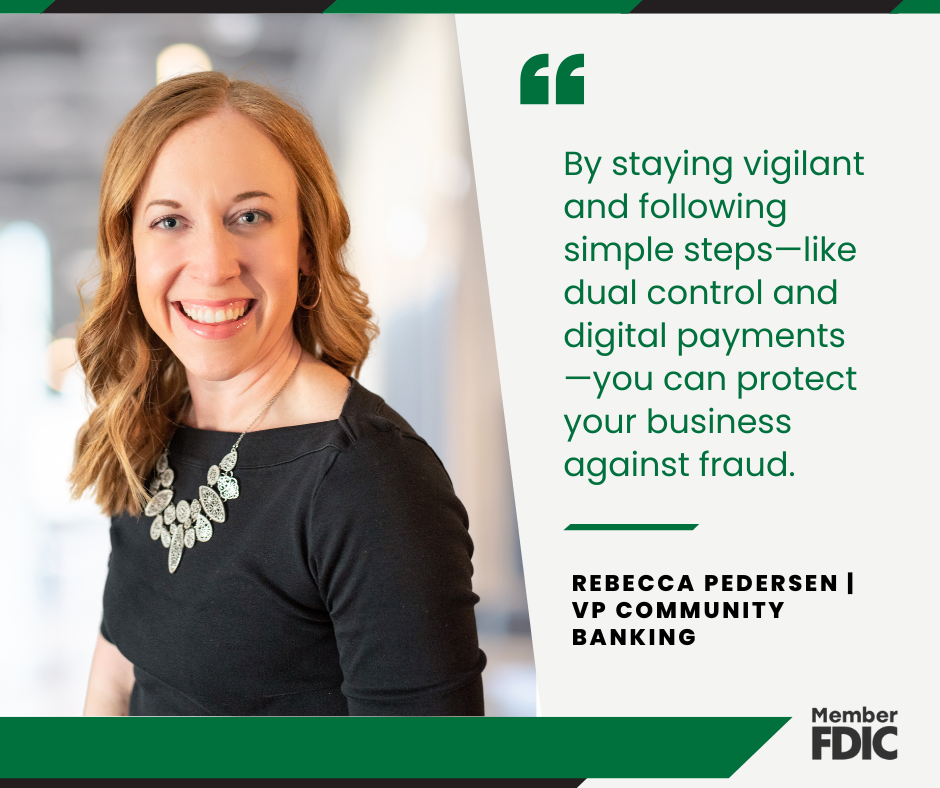
According to Trustpair’s 2024 Fraud Trends and Insights Survey, 96% of U.S. companies faced at least one fraud attempt in the past year. Here are tips from Rebecca Pedersen, VP of Community Banking, for protecting your business accounts.
.png)
Learn how to protect your business
Check Your Account Often. Stay vigilant by regularly reviewing your account statements and transactions daily. Catching unauthorized activities early can help prevent losses.
Use Dual Control. Enhance security by requiring two approvals for ACH or wire transfers. This lowers the risk of fraud and increases accountability.
Go Digital with Payments. Switch as many payments as you can from paper checks to electronic options like bank-to-bank ACH transfers.
Use Positive Pay. For necessary paper check payments, implement Positive Pay. This service checks the amount, check number, and account number against issued checks to ensure only authorized payments are processed.
Train Your Employees. Educate your employees about the importance of account security. Make sure they know how to handle sensitive information and identify phishing attempts.
Separate Business and Personal Finances. If you haven’t already, set up separate personal and business checking and savings accounts. This protects your personal info in case of a breach and helps manage your business better.
Update Software Regularly. Keep your business computers and mobile devices current with the latest security updates and antivirus software to guard against cyber threats.
Visit your local Midstates Bank branch or contact Rebecca at msbnahelp@msbna.com to learn more about how we can support your business finances.
We make it simple. Contact a Business Banker or call us at 1-888-710-9070.
Sources: Trustpair’s 2024 Fraud Trends and Insights Survey
Midstates Bank is a full-service financial institution with branches throughout western Iowa.